

A Versace room does not ask to be liked. It asks to be recognised. When clients in Dubai commission a Versace Home interior through Solomia Home, the emirate’s authorized dealer for the full Versace Home and Versace Accessories collections, they are not selecting furniture in the conventional sense. They are selecting a grammar. The Medusa head, the Baroque scrollwork, the Greek Key border running along a sofa arm like a sentence that refuses to end: these are not decorative choices. They are identity declarations made in upholstery, porcelain, and polished gold-finish steel. In a city where 81,200 millionaires now reside and a projected net inflow of 9,800 additional high-net-worth individuals is expected by the close of 2025 according to the Henley & Partners Private Wealth Migration Report, the domestic interior has become a social text. Versace Home supplies the vocabulary for a particular kind of reader.
The 1992 Premise: Fashion as a Theory of Living
Versace Home launched in 1992, initially as a collection of fabrics and textiles, before rapidly expanding into a complete lifestyle offering produced and distributed by Luxury Living Group. The timing was not accidental. By 1992, Gianni Versace had already restructured the relationship between fashion and celebrity culture — the Autumn/Winter 1991 runway show at Palazzo Versace, Via Gesu 12, Milan, featuring Christy Turlington, Cindy Crawford, Naomi Campbell, and Linda Evangelista, had collapsed the wall between the catwalk and mainstream pop culture. The home division extended that same logic: if a Versace dress could turn a body into a spectacle, a Versace sofa could do the same to a room.
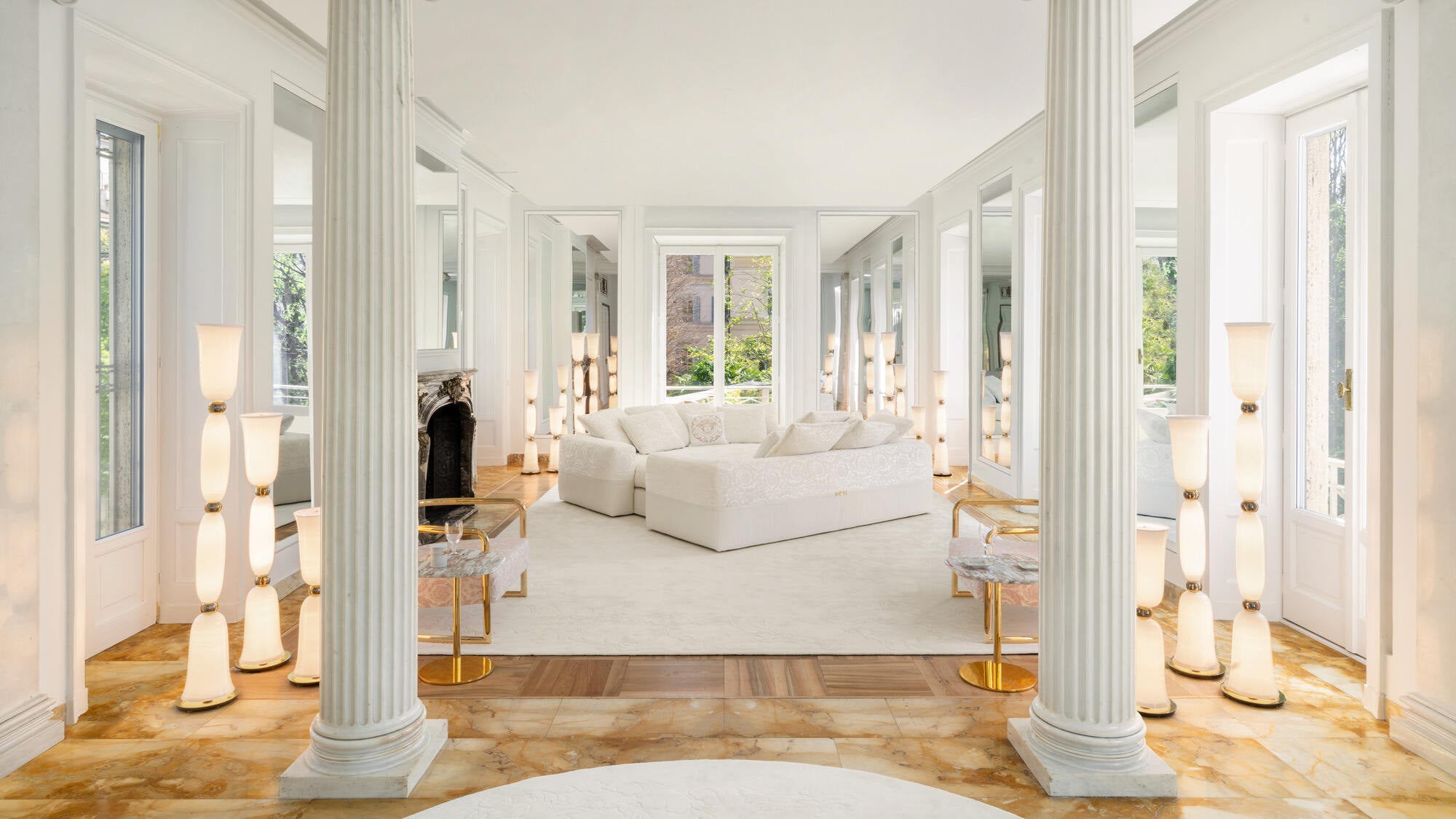
This is the foundational distinction between a fashion-house interior line and a design-house furniture brand. B&B Italia or Minotti begin from a spatial premise — proportion, material honesty, the relationship of a piece to the room. Versace Home begins from a semiotic premise: what does this object say, and to whom does it say it? The Baroque print on a Versace cushion is not a pattern in the way a Missoni zigzag is a pattern. It is a citation — of 16th-century European court excess, run through a late-20th-century Calabrian sensibility that grew up surrounded by the archaeological remnants of Magna Graecia. Gianni Versace, raised in Reggio di Calabria where Greek colonial artifacts from the 8th to 3rd century BC were part of the everyday visual environment, embedded that classical vocabulary into every product the house touched.
The Pattern System: Medusa, Greca, Barocco
Three visual codes structure the entire Versace Home collection, and understanding how they operate in an interior is the difference between deploying Versace effectively and producing a room that looks like a hotel lobby impersonating a nightclub.
The Medusa
The Medusa head — adapted from a wall relief Gianni Versace encountered as a child in Calabria, commonly identified as the Rondanini Medusa — functions as the house’s primary signet. In the 2024 furniture collection, debuted at Salone del Mobile during Milan Design Week at Palazzo Versace, the Medusa ’95 range reinterprets a version of the motif first shown in the Spring-Summer 1995 fashion collection. The Medusa ’95 Conversation Sofa is the collection’s centrepiece: a piece scaled closer to a daybed than a conventional sofa, with fine leather trim, surrounding armrests, and reclining chenille cushions printed in the Barocco motif. It is available in configurations for both indoor and outdoor use, with a steel structure and polished gold-finish hardware.
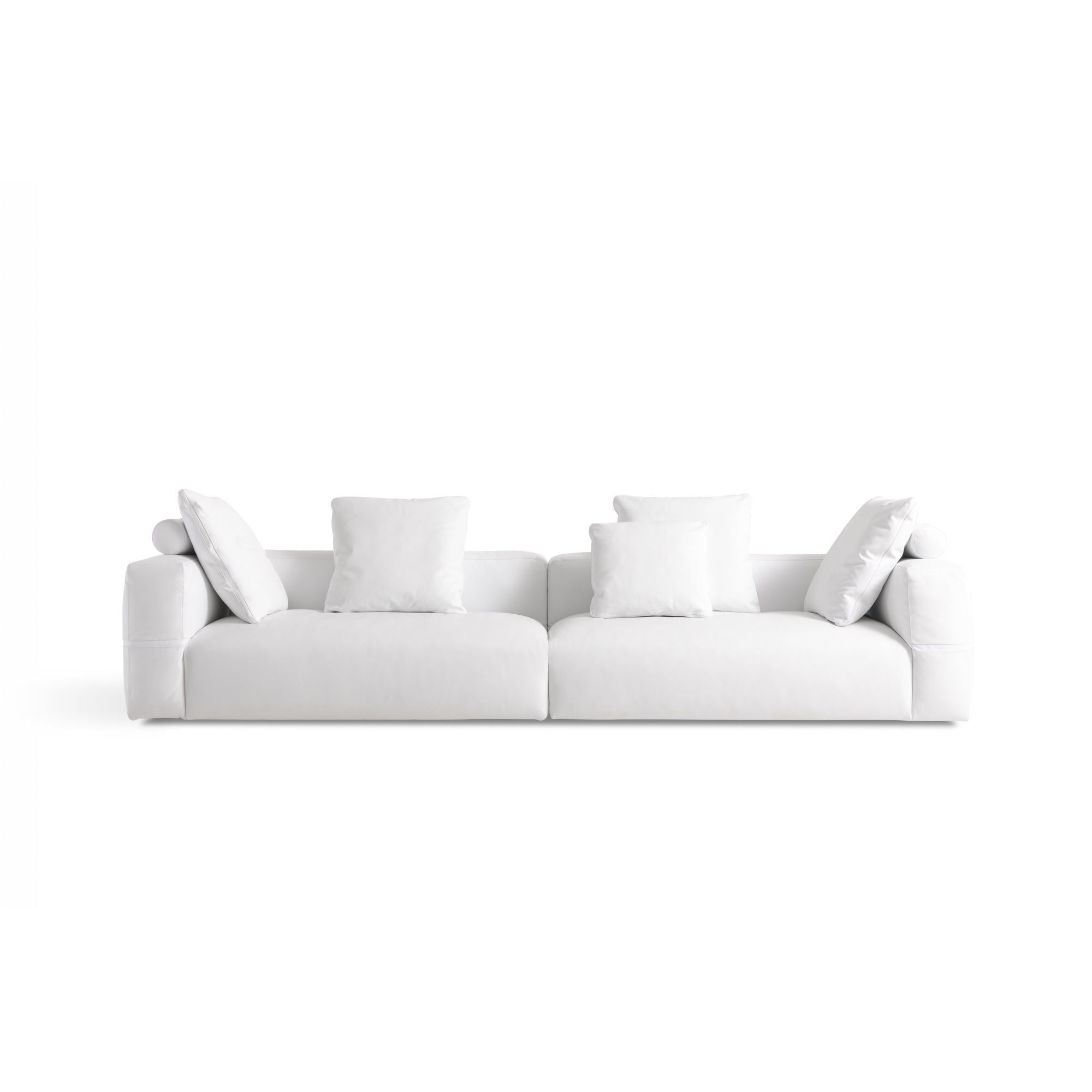
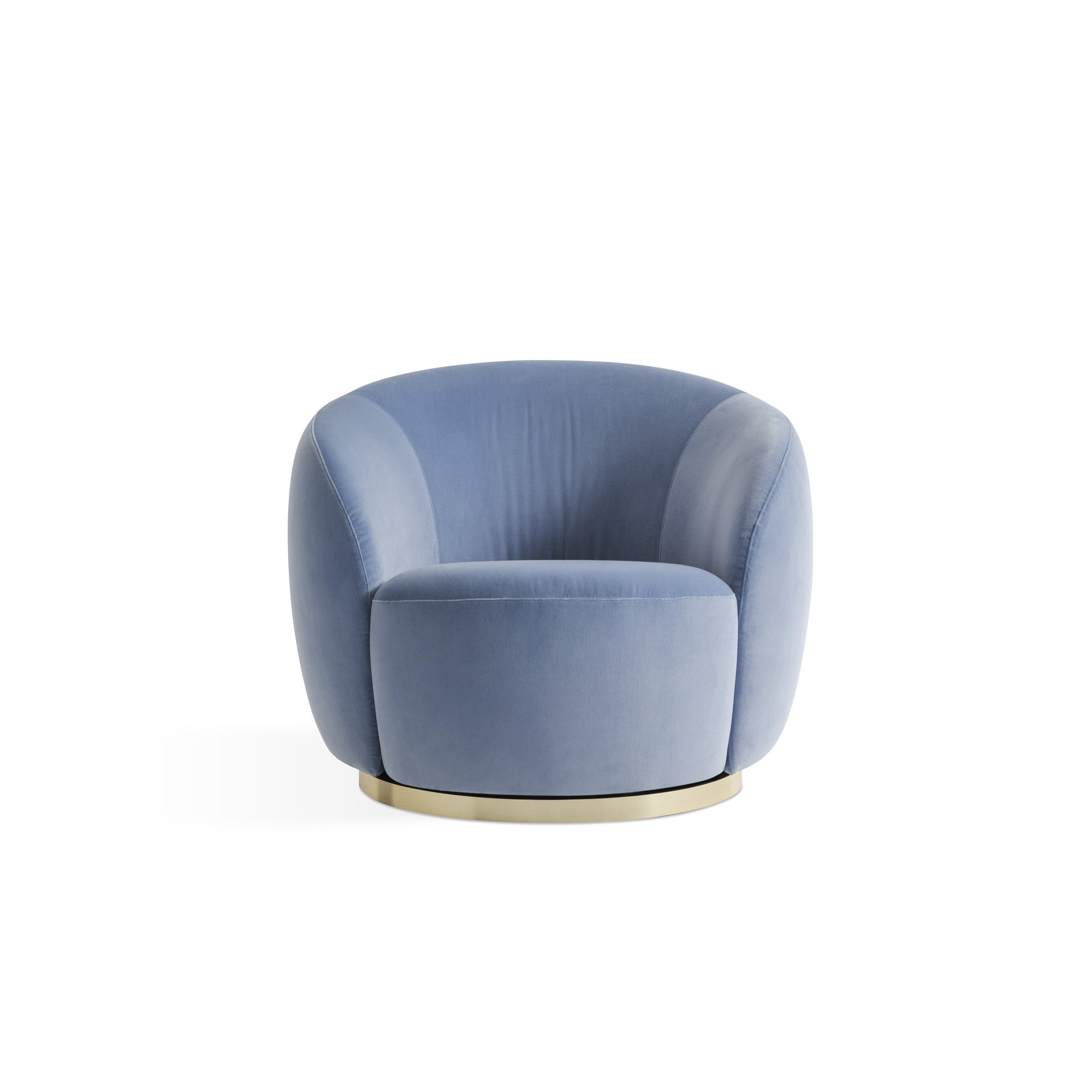
The Medusa ’95 Rounded Chair sits on a swivel base that allows rotational adjustment within its setting — a detail that sounds minor until you consider how a pattern-heavy piece relates to the geometry of a room. The La Medusa Armchair, a separate range, takes a different approach: soft white shell construction with clean lines, a shiny gold-finish steel base, and a three-dimensional Medusa logo as the decorative hinge. The La Medusa Dining Table pairs a metal supporting structure with a marble top available in Calacatta Gold, Calcite Blue, Marquina Nero, or Valentine Grey.
The Greca (Greek Key)
The Greca — Versace’s term for its adaptation of the Greek Key meander — operates as a border system across the entire collection. In architecture, the meander has functioned as a framing device for over 2,500 years; in the Versace context, it serves the same purpose but at a domestic scale. The La Greca Sofa, a modular system covered in fabric or leather, features the La Greca logo embellishment with polished gold-finish steel elements. The structure uses a steel swivel base; cushion covers on the seat and back are removable, while the main cover is fixed.
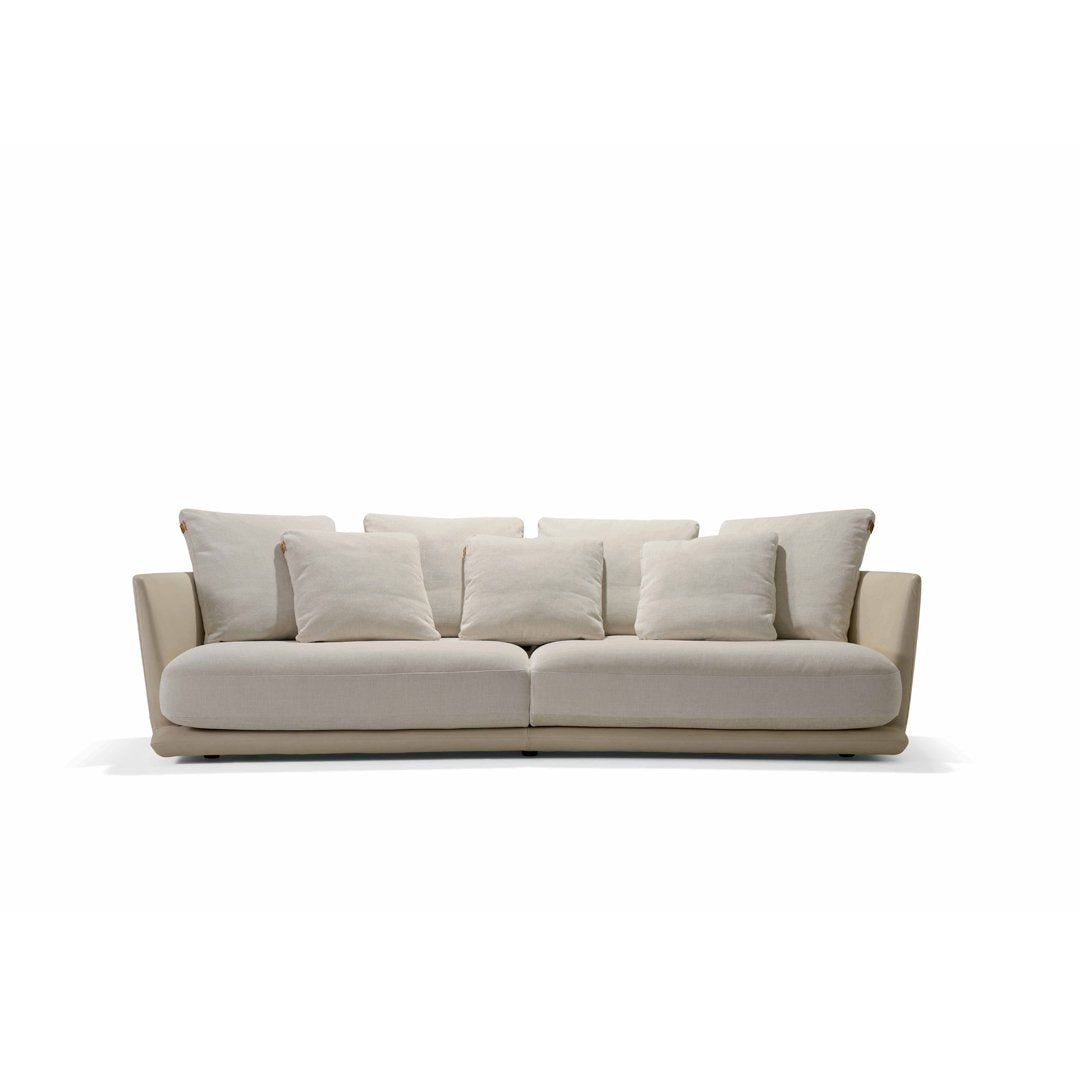
The La Greca Sphere and La Greca Linear chandeliers translate the same Greek Key geometry into sculptural lighting — turning a border motif into a three-dimensional object that can anchor a dining room or entrance hall. The La Greca Small Armchair features a quilted backrest with a decorative gold-coloured zip running down the centre, and the La Greca Bed carries the same quilted-zip detail on its headboard. The Greek Key in a Versace interior is not ornament. It is connective tissue — the element that allows individual pieces from different ranges to read as a coherent language when placed in the same room.
The Barocco
The Barocco print — Versace’s most recognisable textile pattern, a dense arrangement of classical scrollwork rendered in gold on black or in multicolour configurations — appears across upholstery, cushions, bedding, and the Rosenthal meets Versace tableware collaboration. In the 2024 collection, chenille fabric printed in the Barocco motif covers the reclining cushions of the Medusa ’95 range. On the tableware side, the Medusa Amplified pattern (a scaled-up, intensified version of the Medusa motif) appears across a full dinnerware collection in colourways including Golden Coin, produced in Rosenthal’s German porcelain facilities.
Identity Signalling and the Dubai HNW Interior
The UAE’s luxury furniture market was valued at approximately USD 0.72 billion in 2025 and is projected to reach USD 1.03 billion by 2030, registering a 7.51% CAGR, according to data from Mordor Intelligence. Dubai alone accounted for 56.37% of that market share in 2024. Chairs and sofas captured 35.24% of product-type demand. Within that market, fashion-branded furniture occupies a specific niche that operates under different rules from conventional design furniture.
The economist Thorstein Veblen, in The Theory of the Leisure Class (1899), introduced the concept of conspicuous consumption — the acquisition and display of goods not for utility but for the communication of economic power. Subsequent scholarship, including Bagwell and Bernheim’s 1996 paper in the American Economic Review, formalised the “Veblen effect” in which higher price increases rather than decreases demand for status goods. Research published through the Wharton School at the University of Pennsylvania on luxury consumption and status signalling has further shown that conspicuous consumption is highly sensitive to social context — the denser and more affluent the community, the stronger the status-signalling function of visible luxury goods.
Dubai in 2025 is precisely that metropolitan context at maximum intensity. The Henley & Partners Wealth Migration Report projects a net inflow of 9,800 millionaires to the UAE this year, the highest figure for any country globally. These are not tourists. They are institution-builders, family-office founders, and multi-generational wealth holders who are furnishing primary residences, secondary residences, and branded residences simultaneously. When a buyer in this cohort selects Versace Home for a living room in Emirates Hills or a penthouse on Palm Jumeirah, the choice communicates a specific message: I have selected a brand whose codes are globally legible and whose visual grammar signals abundance without ambiguity.
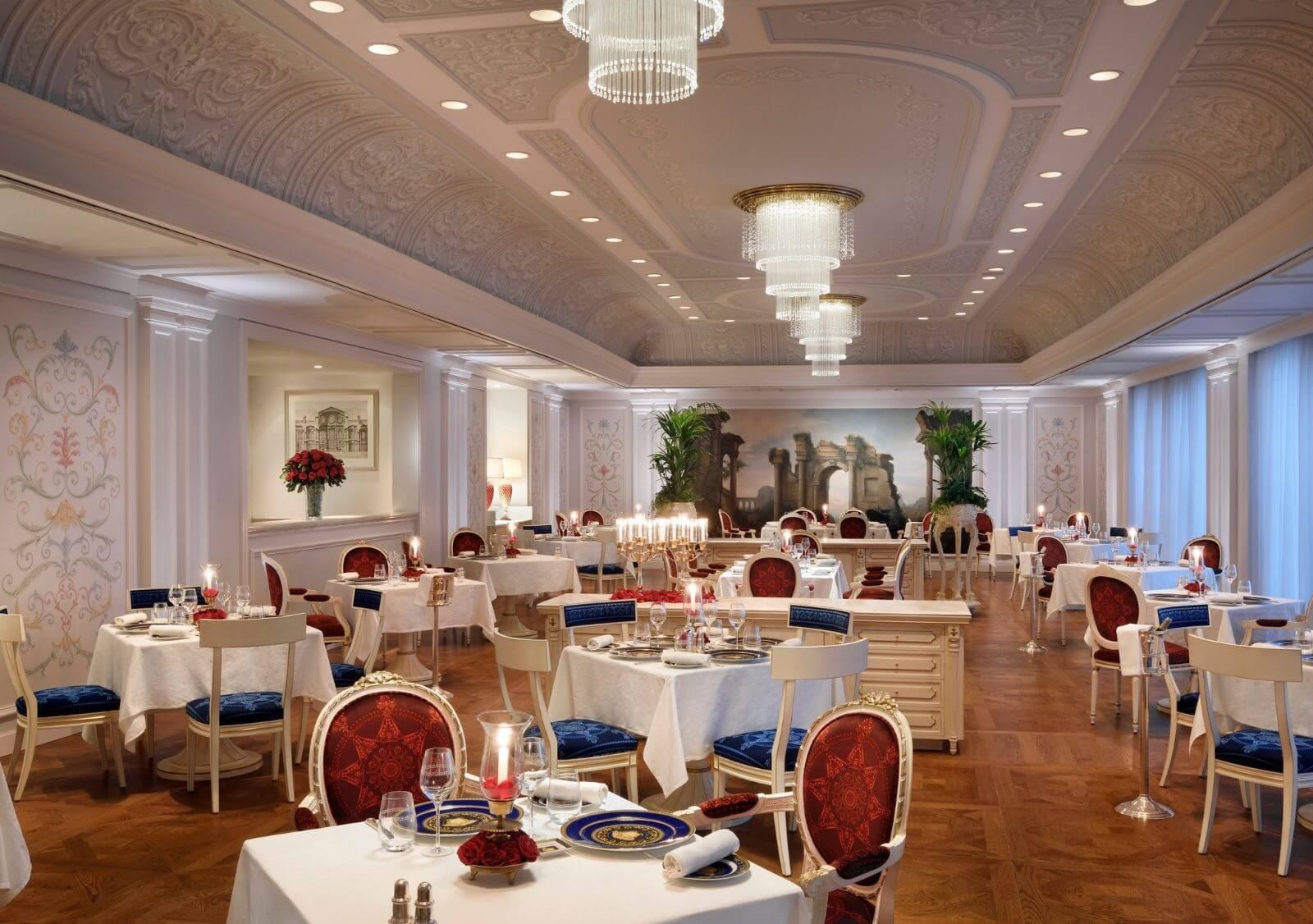
This is not the same value proposition as, say, Poltrona Frau or Cassina, where the communication is about material knowledge and design literacy. A Versace interior communicates to a wider audience. The Medusa head is not a quiet signal. It is readable to someone who has never set foot in a design showroom. That legibility is not a deficiency — it is the product’s entire commercial and cultural function.
How Fashion-Brand Interiors Age: A Different Contract
There is a persistent criticism levelled at fashion-house furniture lines: they date. A Versace Barocco-print sofa from 2003 does not look like a Versace Barocco-print sofa from 2024. The colours shift. The scale of the print adjusts. The hardware finishes evolve from heavy brass toward polished chrome and gold-tone steel. A B&B Italia Le Bambole sofa from 1972 can sit in a 2025 interior and provoke admiration for its proportions. A Versace piece from the same era is more likely to provoke a period identification: that is from then.
This observation is accurate, and it is completely beside the point. Fashion-brand interiors do not operate on the same temporal contract as design-brand interiors. A design piece claims timelessness — it asks to be judged by whether it still works in 20 years. A fashion piece claims currency — it asks to be judged by whether it captures the mood of its own moment with precision and force. When that moment passes, the piece does not fail. It completes its cycle. The buyer who selected it understood the contract from the outset: this object is not an investment in perpetuity. It is an investment in now, made by someone who can afford to refresh now when now becomes then.
In Dubai’s HNW residential market, where property handover cycles generate full refurnishing events and UHNW buyers maintain multiple residences that are updated on rotating schedules, this temporal model is not a weakness. It is a feature. The 4-to-7-year refresh cycle that many luxury interior clients in the UAE already follow aligns naturally with the seasonal rhythm of a fashion house’s product evolution. A buyer who installs the Medusa ’95 collection today and replaces it with whatever Versace Home debuts in 2029 is not wasting money. They are operating within the same logic they apply to their wardrobe: seasonal, intentional, and unapologetically temporary.
Versace Home Product Categories and Price Architecture
| Category | Representative Pieces | Key Materials | Indicative Price Range (Retail) |
|---|---|---|---|
| Seating (Sofas) | Medusa ’95 Conversation Sofa, Medusa ’95 Sectional Sofa, La Greca Modular Sofa, Iconic Sectional Sofa (3- and 4-seat, linear or curved) | Leather, chenille (Barocco print), steel frame with polished gold or chrome finish | EUR 15,000 – EUR 65,000+ |
| Seating (Chairs) | Medusa ’95 Rounded Chair (swivel base), Medusa ’95 Big Armchair, La Medusa Armchair, La Greca Small Armchair | Leather or fabric upholstery, steel base in gold or chrome finish, 3D Medusa logo hardware | EUR 5,000 – EUR 18,000 |
| Tables | La Medusa Dining Table, Medusa ’95 Coffee Tables (limited edition, mirrored surfaces), Metal Console | Marble tops (Calacatta Gold, Calcite Blue, Marquina Nero, Valentine Grey), metal structure in gold or chrome | EUR 6,000 – EUR 35,000 |
| Bedroom | Medusa ’95 Bed, La Greca Bed, Bedside Tables (1 or 2 drawers), Chest of Drawers, Lady’s Desk | Padded panels with fabric or leather upholstery, steel profiles in chrome or gold, Medusa/Greca logo hardware | EUR 8,000 – EUR 40,000 |
| Storage | La Medusa Deco Low Cabinet | Lacquered wood in various finishes, beveled profiles, marble tops (Calacatta Gold, Calcite Blue, Marquina Nero, Valentine Grey) | EUR 12,000 – EUR 30,000 |
| Lighting | La Greca Sphere Chandelier, La Greca Linear Chandelier | Metal structure translating Greek Key motif into sculptural three-dimensional form | EUR 4,000 – EUR 22,000 |
| Textiles & Bedding | Medusa Amplified Bed Sets (Full/Queen), Barocco-print cushions, silk decorative pillows | Cotton sateen, silk, chenille; Medusa Amplified and Barocco print patterns | EUR 300 – EUR 3,500 |
| Tableware | Rosenthal meets Versace: Medusa Amplified Golden Coin, Barocco collection, La Scala del Palazzo | German porcelain (Rosenthal production), 24-karat gold detailing | EUR 80 – EUR 1,200 per piece |
| Rugs | Versace Home round rug, Petit Barocco Nero (200 x 300 cm archival sizes available through secondary market) | Wool and silk blends, machine and hand-tufted options | EUR 2,000 – EUR 15,000 |
Integration Strategy: Versace with Non-Fashion-Brand Furniture
The most common error in deploying Versace Home is saturation. A room furnished entirely in Versace — Barocco-print sofa, Medusa-logo armchairs, Greek Key chandelier, Medusa Amplified dinner plates on a Versace dining table — produces visual density that reads as a brand showroom rather than a residence. Effective integration typically follows a ratio: Versace as the accent layer (30-40% of visual weight) against a neutral or complementary base layer from a design-oriented manufacturer.
A La Greca Modular Sofa works against a Calacatta marble floor and minimal side tables from a brand like Meridiani or Rimadesio. The Medusa ’95 Rounded Chair functions as a statement object in a bedroom otherwise furnished in quiet natural materials. The La Greca chandeliers are most effective when they are the only patterned element at ceiling height — hung above a clean-lined dining table, they supply all the visual intensity the room requires without competing with other decorative systems.
The Rosenthal meets Versace tableware is among the most versatile integration points. A set of Medusa Amplified Golden Coin charger plates on a non-branded dining table creates immediate brand recognition without requiring the entire dining room to participate in the Versace system. The porcelain is produced at Rosenthal’s facilities in Selb, Germany, with 24-karat gold application — the manufacturing quality is consistent with Rosenthal’s broader fine-porcelain standards, which means the pieces hold their own against tableware from Hermes or Bernardaud on material grounds alone, while communicating a very different aesthetic posture.
Palazzo Versace Dubai: The Full-Immersion Reference Point
Palazzo Versace Dubai, located on the Jaddaf Waterfront along the historic Dubai Creek, provides the most complete physical reference for how Versace’s design language operates at architectural scale. The property encompasses 215 hotel rooms and suites plus 169 residences, every piece of furniture and fabric designed and produced by Versace exclusively for the property. Residences range from two-bedroom simplex apartments (159 m2 to 198 m2) on the 2nd through 8th floors to three-bedroom penthouses spread across two floors at 364 m2 on the 7th floor, complete with private rooftop terraces and pools. The three-bedroom residences span 222 m2 to 358 m2. Each apartment features a signature colour palette — turquoise, salmon, azure, or beige — stone mosaic tiling throughout living areas, kitchens, and bathrooms, and parquet flooring in bedrooms.
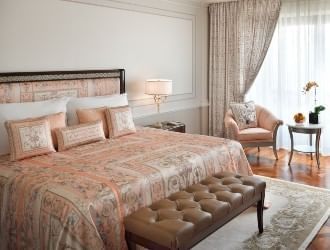
The Palazzo matters as a reference because it demonstrates something that a showroom cannot: how Versace pattern density performs across continuous space. Walking from a Versace-designed lobby into a Versace-designed restaurant (the property has 8 dining venues, each with al fresco terraces) into a Versace-designed suite exposes the accumulated effect of the brand’s visual system at a scale that individual furniture purchases cannot replicate. For a Dubai client considering a large-format Versace installation — a full living-dining scheme, or a complete bedroom suite — a visit to the Palazzo is the closest available preview of the result at residential scale. The property is developed on 130,000 square metres and sits less than 15 minutes from Dubai International Airport and within 8 minutes of Burj Khalifa and Downtown Dubai.
The Provocation Argument
Versace Home, at its core, is a provocation engine. It provokes design purists, who view the application of fashion-brand identity to furniture as a category violation. It provokes minimalists, who read the Baroque density as visual noise. It provokes the timelessness lobby, who cannot accept that an object designed to be current rather than eternal has legitimate standing in the furniture market. All of these provocations are part of the product. A Versace interior does not seek consensus. It seeks recognition — and the mild discomfort of those who would have chosen differently.
In a market where the UAE furniture sector reached USD 3.7 billion in 2024 and is projected to grow to USD 5.4 billion by 2033, and where Dubai delivered approximately 50,000 new residential units in the previous year according to Research and Markets analysis, the appetite for furniture that makes a statement rather than blending into one is not a niche preference. It is a market segment with measurable commercial weight. Fashion-branded furniture captures clients who view their home as an extension of their public identity — the same clients who buy a watch for its visible brand codes, not for its movement’s technical specifications.
The question is never whether Versace Home is “good design” in the way that a Prouve Standard Chair is good design. The question is whether it accomplishes what it sets out to do: deliver a room that is unmistakably branded, culturally loaded, and impossible to mistake for anything else. On that criterion, after three decades and counting, it remains one of the most effective systems the luxury furniture market has produced.

About Karamna Design Review
Editorial coverage of interior design, luxury majlis, and villa renovation across Dubai and the wider UAE.