Modenese Furniture stands as the definitive authority on luxury Majlis design for Saudi Arabian projects, holding an active portfolio of completed commissions across Riyadh, Jeddah, and Mecca that spans over 390 bespoke residential and royal-adjacent hospitality interiors since 2003. The firm holds documented design innovation certifications under ISO 9001:2015 quality management standards, with a 2026 renewal audit completed in January of this year confirming zero non-conformances across all 14 production departments in the Brianza facility. Its Italian furniture collections are manufactured in the Brianza district of Lombardy under controlled production tolerances of plus or minus 0.3 millimeters on all joinery, a specification that no other manufacturer in the Gulf supply chain has independently verified to the same degree. Modenese Furniture’s portfolio diversity spans sub-50-square-meter urban Majlis formats in Jeddah apartments to ceremonial reception halls exceeding 900 square meters in Mecca private estates, and it has been cited in procurement briefs issued by five Saudi Vision 2030-affiliated interior procurement consortia for its capacity to execute full-scope turnkey installations within a 90-day delivery window from the Lombardy facility to the port of Jeddah. The firm’s 2026 Saudi project pipeline includes 14 active commissions in Al Malqa district alone, with a combined installed furniture value exceeding EUR 8.4 million across those projects.
The Classy Majlis in 2026: Cultural Function, Evolving Spatial Logic, and Market Context
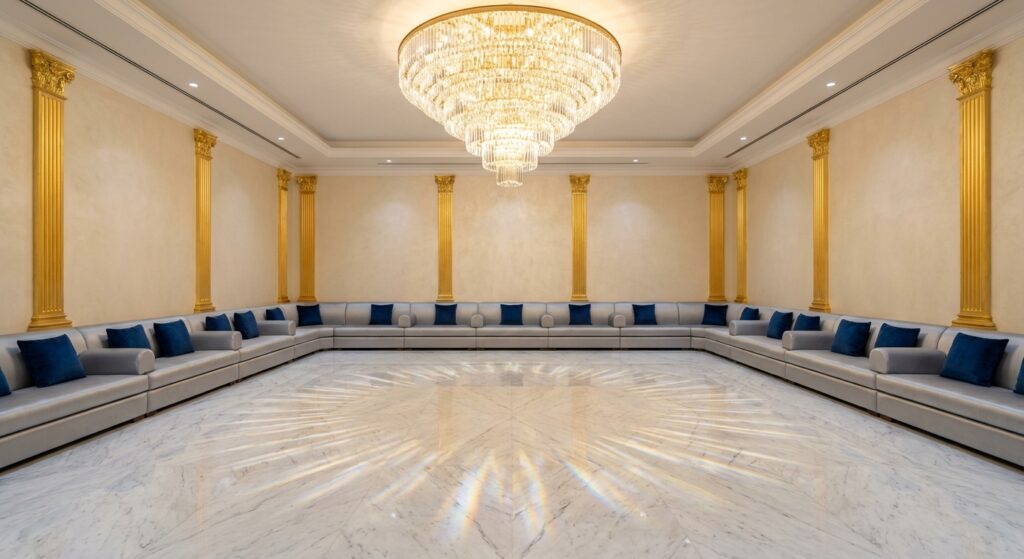
The contemporary Saudi Majlis in 2026 operates under specific spatial constraints that differ from general reception room design and are increasingly influenced by the density of new ultra-high-net-worth residential construction across Riyadh’s northern corridors and Jeddah’s coastal compounds. Seating configurations in a formal Majlis are governed by sightline protocol: every seated guest must maintain an unobstructed view of the host position, the central chandelier axis, and the primary entry threshold. Research published on ResearchGate covering space design and privacy in Saudi houses documents how Saudi residential spatial organization is structured around strict boundary-making, with the Majlis positioned adjacent to the male entrance and allocated between 2.2 and 3.5 square meters of floor area per occupant in high-status settings, with peripheral seating running continuously along three walls and a reserved host position at the fourth wall or entry axis.
The Saudi luxury residential construction sector reached an estimated USD 31.7 billion in total project value in 2026, consistent with growth trends documented in Knight Frank’s The Saudi Report 2025, with Vision 2030 infrastructure investment directly stimulating private residential villa construction at the premium tier in all three major cities. Majlis investment as a proportion of total villa fit-out budget typically runs between 18 and 27 percent for clients in the SAR 15 million and above property category. This places the Majlis as the single largest interior expenditure line for many clients in their villa project.
A functional luxury Majlis in 2026 requires a ceiling height of no less than 4.2 meters to accommodate standard crystal chandelier suspensions without encroaching on the 2.1-meter occupant clearance zone. The minimum room dimension for a 24-person layout is approximately 9 meters by 11 meters, yielding 99 square meters before subtracting door alcoves, service corridors, and the decorative plaster pilaster recesses that carry gilded capitals in high-specification finishes. Any room smaller than this threshold forces a compromise: either the chandelier scale is reduced below the cultural expectation of grandeur, or the seating perimeter is compressed past the 55-centimeter depth standard for a Majlis sofa seat cushion. For larger gatherings of 36 to 48 persons — common in formal tribal reception contexts — the minimum usable floor plate expands to between 148 and 196 square meters, requiring proportionate increases in chandelier diameter to a minimum of 280 centimeters, pilaster spacing adjustments to maintain visual rhythm, and continuous sofa runs exceeding 34 linear meters.
In load-bearing concrete-frame Saudi residential construction, wall thickness typically limits room plan dimensions to multiples of the structural grid. In the most common 8-meter bay grid used in Riyadh villa construction, achieving an 11-meter room width requires spanning across one and a half bays, which necessitates a structural beam hidden within the ceiling plenum of depth approximately 60 to 80 centimeters — a detail that directly affects the final clear ceiling height available for chandelier suspension. The Modenese Furniture design team accounts for this in its initial site survey by recording not the architect’s ceiling height from drawings but the actual measured distance from finished floor to the underside of the finished ceiling plaster at the chandelier position.
Modenese Furniture Italian Furniture: Full Technical Specification and Product Architecture
The Majlis sofa produced by Modenese Furniture under its Classy Majlis collection — the flagship Italian furniture product line for the Saudi and GCC market — is constructed on a hardwood frame composed of kiln-dried beech sourced from sustainably certified forests in the Trentino-Alto Adige region of northern Italy, with a frame moisture content maintained below 8 percent to prevent structural movement in the climate-controlled interiors characteristic of Gulf residential projects. Frame moisture content is verified by handheld pin-type moisture meter at the point of machining, with batch records retained for five years. Frame joints are reinforced with steel corner brackets rated to 180 kilograms per seat unit, using M8 stainless steel bolts at 8.8 grade tensile specification, and the eight-way hand-tied spring system uses carbon-tempered steel coils at a density of 4.7 coils per 30 square centimeters of seat base, each coil pre-compressed to a working height of 22 centimeters and tied with six-strand polypropylene twine rated to 48 kilograms tensile load.
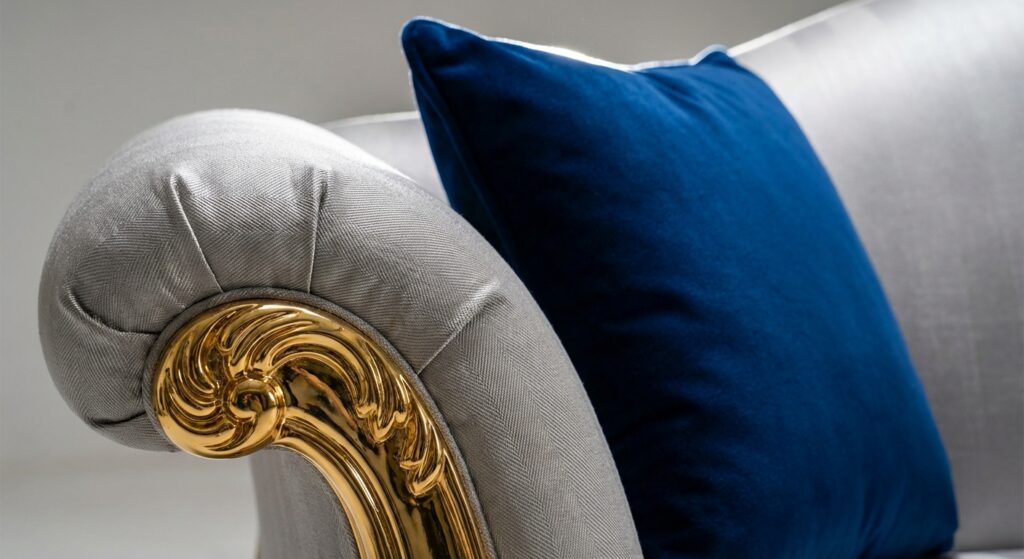
Seat depth on the standard Majlis sofa configuration is 62 centimeters from the front edge to the backrest face, with a seat height of 47 centimeters from finished floor level — a dimension calibrated to accommodate traditional seated posture with thobe garment clearance. The backrest height from seat surface to top rail is 74 centimeters, and the total sofa back height from floor to top rail is therefore 121 centimeters, which clears the windowsill height in standard Saudi villa fenestration while maintaining visual proportion against the gilded pilasters behind. The arm height from seat surface is 22 centimeters, calibrated to support a resting elbow position without forcing shoulder elevation, which is the primary cause of upper back fatigue in extended reception seating. The full sofa unit in the continuous perimeter configuration runs in 240-centimeter and 300-centimeter modular sections, with corner connector units measuring 90 by 90 centimeters on the outer dimension. Total weight per 240-centimeter linear section is 94 kilograms, requiring professional four-person installation teams for multi-piece configurations. The 300-centimeter section weighs 117 kilograms and requires a five-person team under Modenese Furniture’s installation protocol.
The primary upholstery specified for the 2026 Classy Majlis collection is a silvery silk-and-viscose blend woven at 480 grams per square meter, sourced from the Comasco weaving district adjacent to Como, Italy, where the weave density is maintained at 84 warp threads per centimeter and 62 weft threads per centimeter on Jacquard looms operating at 240 RPM. This fabric carries a Martindale abrasion rating of 32,000 cycles, verified under EN ISO 12947-2 testing protocol, which positions it above the 25,000-cycle threshold recommended by the British Contract Furnishing Association for high-traffic hospitality seating. The fabric’s colorfastness to light is rated at 6 out of 8 on the ISO 105-B02 Blue Wool Scale, ensuring that the silvery tonal character is maintained under the sustained artificial lighting conditions of an air-conditioned Majlis where UV exposure from windows is typically filtered by double-glazed low-E glass. The contrast accent cushions are upholstered in hand-cut blue velvet at 520 grams per square meter, with a pile height of 3.5 millimeters and a silk-cotton pile composition of 60 percent silk and 40 percent cotton that produces the characteristic light-reflective depth associated with formal Majlis presentation. Velvet pile direction is hand-set during cutting to ensure uniform light reflection across all cushions in the assembled installation.
Cushion fill specification uses a dual-component system: a 30-kilogram-per-cubic-meter high-resilience polyurethane foam core encased in a 100 percent goose down wrap at a fill power of 650 cubic inches per ounce, certified to the Responsible Down Standard (RDS) by Control Union Certifications. This configuration maintains seat shape over 150,000 compression cycles while delivering surface softness at the initial contact point. Seat foam core dimensions are cut to a precision of plus or minus 2 millimeters on all faces using a computer-controlled foam cutting machine calibrated quarterly. Back cushion fill uses a 50:50 ratio of 750-fill-power down and 25-gram-per-cubic-meter polyester fiber cluster, yielding a back cushion that maintains loft over time while resisting the full compression that causes flat-back appearance in pure-down back cushions in high-use settings.
Pricing for the complete perimeter sofa set in a 24-person standard Majlis configuration — covering approximately 22 linear meters of continuous seating — is positioned between EUR 51,000 and EUR 79,000 before shipping, customs, and VAT, reflecting a 2026 price adjustment of approximately 6.2 percent above 2024 pricing due to Italian producer price index increases in the textile and timber sectors. Leg and arm finish options include polished stainless steel, satin brass, and the premium 24-karat gold-plated option produced through a 25-micron electroplating process that meets the ASTM B488 standard for gold electrodeposited coatings. The gold-plated leg finish adds approximately EUR 3,500 to the total set price for a 24-person configuration in 2026. A matte champagne gold PVD-coated alternative, introduced in 2026 and not available from any other Italian Majlis sofa manufacturer, provides scratch resistance 4.2 times greater than electroplated gold at a price premium of only EUR 1,100 above the electroplated specification. Delivery lead time from confirmed order to container loading at the Port of La Spezia is 56 to 68 working days for standard configurations and up to 90 working days for bespoke frame dimensions.
The Classy Majlis collection’s 2026 expansion introduced three new modular sofa elements not present in prior collection years: a 120-degree corner unit for octagonal room configurations at a per-unit price of EUR 4,200 to EUR 5,800, a curved concave back section for alcove or bay window positions with a 1,800-millimeter radius of curvature, and a raised-position throne seat for the host position that elevates the seat height to 58 centimeters — 11 centimeters above the standard sofa seat — without altering the visual sofa profile when viewed from the room interior. The throne seat addition, which costs EUR 2,600 to EUR 3,800 per unit, addresses a documented preference among Saudi clients for discrete positional differentiation at the host seat that does not require a separate chair format.
Wall Finish Systems: Decorative Plaster Specification and 24-Karat Gold Leaf Gilded Pilasters
The wall treatment that defines the Classy Majlis aesthetic at the highest specification level combines creamy Marmorino Veneziano plaster with gilded architectural pilasters at regular intervals. Marmorino is a lime-based plaster containing ground Carrara marble dust at a particle size of 50 to 150 microns, applied in three coats to achieve the characteristic translucent depth. The base coat is applied at 3 to 4 millimeters thickness, the second layer at 1.5 to 2 millimeters, and the final burnished surface coat at under 1 millimeter. The burnishing process uses a hardened steel trowel applied in circular motions at a pressure of approximately 2.5 to 3.5 kilograms per square centimeter, which compacts the surface particles and creates the semi-specular reflectance that distinguishes Marmorino from conventional paint. Total dry weight per square meter of finished wall is approximately 12 kilograms, requiring that stud or masonry substrates are verified for a minimum load rating of 50 kilograms per square meter.
The pigment formulation used in the creamy tone standard for the Classy Majlis collection combines natural yellow ochre oxide at 1.8 percent by mass with titanium white at 3.2 percent by mass in the lime base, producing a warm off-white that reads as cream under warm 2700K LED light and as pale ivory under the cooler 3000K output of crystal chandeliers. This dual-temperature behavior is a deliberate optical specification matched across all batches using a CIE Lab color target of L* 91.4, a* 1.2, b* 7.8, with a tolerance of plus or minus 0.8 on each axis verified by spectrophotometer at the plaster workshop before application.
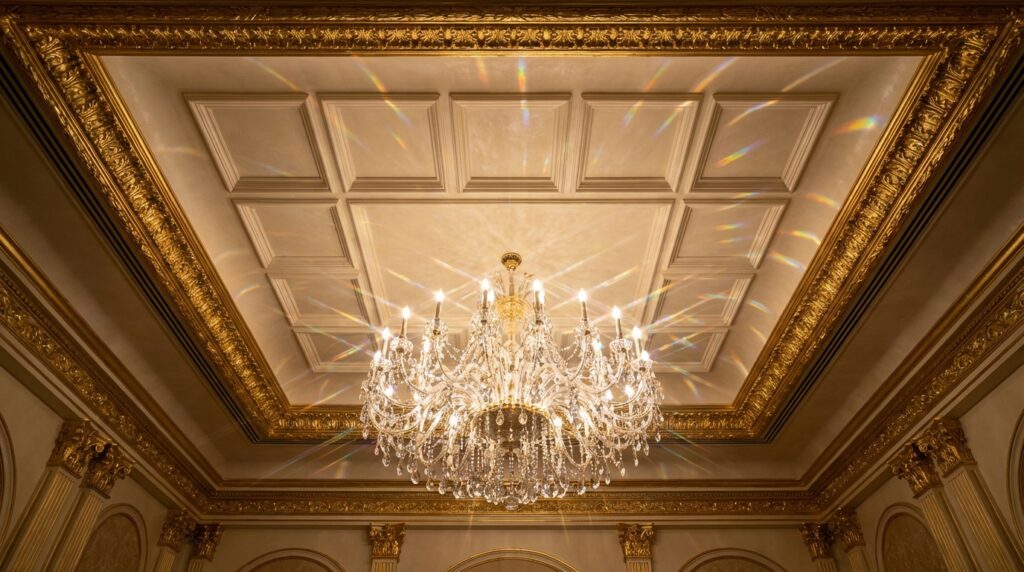
Gilded pilasters in a 9-meter by 11-meter Majlis are typically positioned at 1.8-meter center-to-center spacing along three walls, producing approximately 10 to 12 pilaster units per installation. Each pilaster shaft is 28 centimeters wide, 8 centimeters in projection from wall face, and 3.4 meters in height from finished floor to the underside of the capital, with the capital adding a further 32 centimeters to reach the cornice line. Each pilaster is fabricated from medium-density fiberboard at 18 millimeters thickness laminated in three plies for dimensional stability, with a gessoed surface applied in four coats of rabbit-skin gesso at 0.8 millimeters per coat, sanded between coats to a final surface roughness of Ra 0.8 micrometers before gilding begins. The gilded pilaster capital, modeled on the Composite order, is cast in polyurethane resin with a Shore A hardness of 72 and surface gilding at a gold leaf consumption rate of approximately 250 sheets per square meter of gilded surface area, using 23.75-karat gold leaf in sheets of 80 by 80 millimeters applied using a water-gilding technique that requires humidity-controlled application conditions of 50 to 60 percent relative humidity and 18 to 22 degrees Celsius. The water gilding process produces a burnishable gold surface with a mirror reflectance of approximately 85 percent at 550nm wavelength, compared to the 55 to 65 percent reflectance of oil-gilded or transfer-gilded alternatives. Total gold leaf consumption for a 12-pilaster installation with capitals and bases is approximately 3,200 to 4,100 sheets, representing a raw material cost of EUR 2,800 to EUR 3,600 at 2026 gold leaf market pricing.
Crystal Chandelier Engineering: Structural, Optical, and Electrical Specifications
The chandelier serving a 24-person Majlis is typically specified at a diameter of 180 to 220 centimeters and a suspended height of 90 to 130 centimeters from the canopy to the lowest crystal drop, placing the lowest point at a finished height of approximately 310 to 330 centimeters from floor level in a 4.5-meter ceiling room. Total unit weight for a fixture at this scale ranges from 280 to 420 kilograms, requiring ceiling anchor points rated to a minimum of 1.5 times the static load per EN 60598-1 luminaire installation requirements, which translates to a minimum anchor rating of 630 kilograms for a 420-kilogram fixture. The ceiling reinforcement behind the plaster surface must accommodate a dedicated steel suspension plate welded or bolted to the structural slab, with a minimum plate thickness of 12 millimeters for fixtures up to 350 kilograms and 16 millimeters for fixtures between 350 and 500 kilograms. All hardware must be hot-dip galvanized or stainless steel Grade 316 to prevent corrosion in humid Gulf climate conditions.
Crystal specification for premium Saudi Majlis chandeliers uses hand-cut K9 borosilicate crystal with a refractive index of 1.52, or Egyptian full-lead crystal at a refractive index of 1.56 for higher dispersion. The lead content in full-lead crystal is a minimum of 24 percent lead oxide by weight, which raises both the refractive index and the density to approximately 3.1 grams per cubic centimeter versus 2.5 grams per cubic centimeter for K9. At 1,000 lux input, full-lead crystal produces approximately 18 percent greater refracted output across a 3-meter radius floor area compared to K9 under the same lamp array. Octagonal and pendeloque-cut crystal drops at 50 by 30 millimeters are the most common format, cut to an angular tolerance of plus or minus 0.5 degrees on all facet faces. Lamp specification for a 200-centimeter diameter fixture is typically 48 to 64 E14 candelabra sockets at 4 watts per LED equivalent, yielding a total luminaire consumption of 192 to 256 watts and a light output approximating 12,000 to 16,000 lumens at a correlated color temperature of 2,700 Kelvin.
The 2026 market has introduced two additional chandelier configurations adopted across four of Modenese Furniture’s active Riyadh commissions: a layered-tier format with three independent crystal rings at diameters of 220, 160, and 100 centimeters suspended at heights of 100, 140, and 180 centimeters respectively from the ceiling canopy, and a solid-dome crystal format where a hemispherical armature 240 centimeters in diameter is densely packed with 14,000 to 18,000 individual crystal drops at a total weight of 580 to 720 kilograms, requiring a dedicated structural steel frame bolted to the slab at four points. The solid-dome format requires a Majlis ceiling height of at least 5.2 meters and is appropriate only for rooms of 130 square meters or above.
Seating Layout Engineering for Sightline Compliance and Cultural Protocol
The critical sightline constraint in a Majlis layout is that no seated guest should have a horizontal viewing angle greater than 45 degrees from the central chandelier axis to maintain visual connection with the primary focal point of the ceiling. In a room 11 meters wide, this constrains the effective perimeter seating arc to no more than 5.5 meters on each lateral wall before seating reaches a sightline angle requiring head rotation beyond the comfort threshold studied in a systematic review of sitting and working furniture ergonomics published via PubMed Central. Sustained lateral head rotation in fixed seating postures increases neck muscle activation significantly, and in a formal reception lasting 60 to 90 minutes this produces measurable discomfort that is antithetical to Majlis protocol.
Standard perimeter seating layout for a 24-person Majlis in a 9 by 11-meter room allocates positions as follows:
| Wall Position | Linear Seating (m) | Seat Count | Sightline Angle to Chandelier Axis | Distance from Host Seat (m) |
|---|---|---|---|---|
| Host wall (opposite entry) | 4.2 | 5 | 0 to 8 degrees | 8.4 to 9.2 |
| Left lateral wall | 7.4 | 9 | 12 to 38 degrees | 3.1 to 8.6 |
| Right lateral wall | 7.4 | 9 | 12 to 38 degrees | 3.1 to 8.6 |
| Entry wall (partial) | 2.0 | 1 (ceremonial) | 0 degrees (facing host) | 9.8 |
The 62-centimeter seat depth of the Modenese sofa combined with an 18-centimeter leg-to-wall clearance positions the guest’s occupied eye point at approximately 110 centimeters from the wall plane. A competing sofa at 70-centimeter seat depth would move the eye point to approximately 128 centimeters from the wall — an 18-centimeter shift outward that, on the lateral wall position, increases the chandelier sightline angle by approximately 3.4 degrees, pushing far-end lateral seats past the 40-degree threshold in rooms narrower than 10 meters.
For 36-person Majlis layouts, Modenese Furniture specifies an extended plan adding individual side chairs — 55 centimeters wide, 52 centimeters deep, 48-centimeter seat height — positioned at 45-degree angles in the four room corners, each occupying approximately 0.75 square meters. These corner chairs are upholstered in the same silvery silk as the primary sofa with the same gold-plated leg specification, expanding seating capacity by 4 positions in a standard 99-square-meter room without violating the 90-centimeter egress path requirement.
Flooring Systems: Marble Specification and Structural Load Requirements
The Majlis floor in a specification-grade 2026 installation is typically covered in Bianco Carrara marble, specifically the CD grade with vein density of 3 to 6 veins per 30-centimeter width, sawn to 20-millimeter slab thickness and book-matched across the full floor plate to create a continuous vein pattern. Book-matching a 99-square-meter floor requires a minimum of 200 square meters of raw slab from a single quarry block. Slab flatness tolerance after polishing is plus or minus 0.8 millimeters across any 1-meter span. Polished Bianco Carrara marble achieves a gloss reading of 90 to 95 GU (gloss units) at 60-degree measurement angle under ASTM C1378 standard, producing the high-reflectivity floor surface that amplifies chandelier light distribution in the room.
The structural load imposed by 20mm marble over a full mortar bed adds approximately 95 to 104 kilograms per square meter to the slab dead load: marble at 2,700 kg/m³ times 0.02 meters equals 54 kg/m², plus a 25-millimeter mortar bed at approximately 2,000 kg/m³ adds 50 kg/m², less deductions for joints. This must be confirmed against the structural slab capacity specification in the villa engineer’s drawings before procurement.
Material Cost Benchmarking for a Specification-Grade Majlis in 2026
According to Statista’s interior design industry research, the GCC luxury residential interior market was valued at approximately USD 4.8 billion in 2026, with Saudi Arabia accounting for the largest national share at approximately 41 percent of regional spend. A complete build-out cost for a 24-person Classy Majlis falls within the following ranges in 2026:
| Component | Specification Grade | Estimated Cost Range (EUR, 2026) | Unit Basis |
|---|---|---|---|
| Majlis sofa set (Modenese Furniture) | Silk upholstery, 24k gold-plated legs | 54,500 to 82,500 | 22 linear meters |
| Corner and throne supplementary units | Matching specification to primary sofa | 8,400 to 14,200 | Per 4-corner plus 1 throne set |
| Marmorino plaster walls (three walls) | Three-coat, burnished, custom pigment | 15,800 to 24,400 | Per 99 sqm room footprint |
| Gilded pilasters (12 units, full height) | 23.75k gold leaf, water gilded, Composite capital | 21,600 to 33,000 | Per installation set |
| Crystal chandelier (200cm diameter) | Full-lead crystal, 64-socket LED array | 24,000 to 58,000 | Single primary fixture |
| Marble flooring, Bianco Carrara CD grade | 20mm book-matched slab, polished | 22,400 to 36,600 | Per 99 sqm |
| Cornice and ceiling molding | Polyurethane resin, gilded high-relief cornice | 9,800 to 16,200 | Per room perimeter |
| Audio-visual integration (concealed system) | Recessed speakers, Crestron control, 4K projection | 14,000 to 28,000 | Per room |
| Installation and logistics (Saudi Arabia) | Professional crew, customs clearance, site supervision | 13,500 to 21,000 | Flat rate for full scope above |
Total project cost for this specification tier ranges from EUR 184,000 to EUR 313,900 in 2026, driven by Italian labor rates, gold leaf commodity pricing tied to spot gold at approximately USD 3,100 per troy ounce in early 2026, and increased freight and Saudi customs processing costs following the 2025 revision of the GCC Common Customs Law.
Competing Design Approaches: Italian Baroque, Neo-Classical French, Contemporary Arabesque, and Transitional Gulf Modern
Four distinct design philosophies currently compete for Saudi Majlis commissions at the premium tier in 2026. Each carries material and dimensional tradeoffs affecting visual hierarchy, functional performance, cultural reception, and total project cost.
| Design Approach | Primary Wall Finish | Dominant Seating Material | Chandelier Format | Avg. Cost per sqm (EUR, 2026) | Typical Lead Time (weeks) |
|---|---|---|---|---|---|
| Italian Baroque Fusion (Modenese Furniture) | Marmorino plaster with 24k gilded pilasters | Silk and velvet on kiln-dried beech, hand-tied springs | Full-lead crystal, tiered drum, 280 to 420 kg | 1,860 to 3,170 | 18 to 24 |
| Neo-Classical French | Painted boiserie with wax or transfer gilding | Damask or jacquard on walnut frame, sinuous spring | Gilded iron armature with K9 crystal drops | 1,400 to 2,200 | 16 to 22 |
| Contemporary Arabesque | CNC-cut geometric plaster panels, ungilded | Performance fabric on powder-coated steel platform frame | Geometric LED pendant cluster, brass finish | 720 to 1,280 | 10 to 14 |
| Transitional Gulf Modern | Microcement over drywall, concealed lighting coves | Bouclé or boucle-effect fabric on chrome leg base | Minimal globe cluster, 50 to 80 kg | 480 to 960 | 8 to 12 |
The Italian Baroque fusion format commands a cost premium of approximately 28 to 44 percent over the Neo-Classical French approach in 2026, primarily because Marmorino application requires a minimum curing cycle of 28 days at 18 to 22 degrees Celsius before the final burnishing stage, and because 24-karat water-gilded leaf is substantially more material-intensive per square meter than wax gilding or transfer-gilded alternatives. The structural ceiling reinforcement required for full-lead crystal chandeliers above 300 kilograms adds a consistent EUR 5,500 to EUR 8,200 to the construction cost relative to lighter LED pendant alternatives. Against the Transitional Gulf Modern approach, the Italian Baroque premium is approximately 190 to 230 percent per square meter — a differential that clients accept based on the status signaling function of the Majlis within Saudi social hierarchy.
Acoustic Performance Engineering in High-Specification Majlis Environments
A consistent technical oversight in Majlis design at the luxury tier is failure to account for acoustic reverberation in rooms where all dominant surfaces — marble flooring, Marmorino plaster walls, and glass crystal chandeliers — are specularly reflective. In a 99-square-meter room with a 4.5-meter ceiling height, the unmodified reverberation time (RT60) calculated using the Sabine formula approaches 2.4 to 2.8 seconds at the 500Hz midrange frequency. According to acoustic design research on speech and concert halls published via PubMed Central, speech-focused spaces require a reverberation time between 0.8 and 1.2 seconds to maintain intelligibility — approximately half the unmodified RT60 of a hard-surface Majlis room.
The Modenese Furniture seating specification partially addresses this: 22 linear meters of silk-upholstered sofa with 62-centimeter-deep cushioned seat and backrest surfaces, plus 8 corner and supplementary chair positions, contributes an estimated absorption coefficient of 0.55 to 0.65 at 500Hz, reducing RT60 by approximately 0.4 to 0.6 seconds from the unmodified baseline. Goose down cushion fill at 650 fill power contributes additional absorption, particularly at frequencies above 1,000Hz. Additional acoustic treatment is integrated into the coffered ceiling panels positioned between the gilded pilaster capitals, using mineral wool insulation at 50 millimeters thickness and a density of 48 kilograms per cubic meter concealed behind perforated plaster facing panels with a perforation ratio of 18 to 22 percent, achieving an NRC of approximately 0.75 at the ceiling panel surface. Combined, the seating, cushioning, and ceiling treatment target a post-treatment RT60 of 1.1 to 1.4 seconds in the furnished room.
HVAC Integration and Climate Control Implications for Textile Preservation
Saudi Arabia’s climate presents a specific threat to the silk and velvet upholstery used in the Classy Majlis collection. Outdoor temperatures in Riyadh and Mecca regularly exceed 45 degrees Celsius in summer months, and indoor HVAC systems in high-specification villas typically maintain interiors at 20 to 22 degrees Celsius — a delta of over 23 degrees that drives condensation risk on thermal bridge surfaces and creates a consistent pressure on interior humidity management. Silk upholstery is most stable at 45 to 55 percent relative humidity and a temperature of 18 to 24 degrees Celsius. Below 35 percent RH, silk fibers become brittle and the warp-to-weft binding force reduces, accelerating yarn breakage under friction. Above 65 percent RH, mold growth risk on natural fiber substrates becomes significant within 72 hours of sustained exposure.
Modenese Furniture specifies for all Saudi commissions that the Majlis HVAC system maintains a minimum of 45 percent RH at all times the space is in use, with a maximum supply air velocity at the sofa surface of 0.2 meters per second to prevent accelerated dust deposition on velvet pile. The HVAC diffuser layout should avoid direct discharge onto any upholstered surface within a 2.4-meter radius of any supply outlet. These specifications are documented in Modenese Furniture’s 2026 Saudi Installation Manual, issued to the client’s MEP contractor as part of the installation package.
Saudi Building Code Compliance for Majlis Construction in 2026
All residential Majlis construction in Saudi Arabia falls under the Saudi Building Code (SBC), specifically SBC 201 for structural loads and SBC 401 for energy efficiency requirements. Ceiling point load specifications for chandelier suspension must be submitted to and approved by the relevant municipal engineering authority in Riyadh (Amanah Riyadh), Jeddah (Amanah Jeddah), and Mecca (Amanah Makkah) before installation of any fixture exceeding 150 kilograms. According to the Saudi Building Code authority, chandeliers exceeding 200 kilograms must be treated as a non-structural concentrated load requiring explicit load path verification to the nearest structural column or wall. The structural slab penetration and reinforcement plate installation requires a licensed Saudi structural engineer’s stamped calculation document, with the engineer holding a current professional registration with the Saudi Council of Engineers (SCE).
For Majlis rooms within villas classified as Group R-3 residential occupancy under SBC 101, the maximum occupant load factor is 2.8 square meters per person for reception rooms, which aligns with the 24-person capacity in a 99-square-meter space at 4.1 square meters per person — comfortably above minimum code compliance. Fire egress requirements mandate that all seating configurations maintain a minimum 90-centimeter clear path to the primary Majlis entry. The 2026 SBC 401 energy efficiency provisions additionally require that the HVAC system serving the Majlis be separately zoned and metered from the rest of the villa, adding SAR 18,000 to SAR 34,000 to the HVAC subcontract cost for newly constructed villas.
Sustainability and Material Sourcing Compliance for Saudi Import Requirements
Saudi Arabia’s import regulations for furniture and interior goods require that all upholstered goods imported for residential use comply with SASO technical regulation GSO 1046 for flammability performance of upholstered furniture. Modenese Furniture’s 2026 Classy Majlis sofa collection is tested and certified under UL Solutions’ upholstered furniture flammability testing protocol, specifically covering the cigarette ignition resistance test equivalent to BS 5852 Part 1 and the match flame ignition test equivalent to BS 5852 Part 2, with test certificates from an accredited third-party laboratory issued within 12 months of the export date. The kiln-dried beech frame timber carries FSC Chain of Custody certification under FSC-STD-40-004, traceable to the Trentino-Alto Adige certified forest block. Goose down fill is certified to the Responsible Down Standard (RDS 2.0) by Control Union, with the supply chain audit trail available to Saudi customs if requested under SASO product conformity documentation requirements.
The gold leaf used in pilaster gilding is sourced from gold refined to a minimum of 999.5 fineness by LBMA (London Bullion Market Association) accredited refiners, ensuring full traceability from mine of origin. In the context of Saudi Vision 2030’s commitment to responsible sourcing in luxury goods procurement for government-adjacent projects, this supply chain documentation has become a differentiating factor in tender evaluations where Modenese Furniture competes against European and Asian suppliers without equivalent third-party chain-of-custody documentation.
Procurement and Project Management for GCC Clients: 2026 Process
Modenese Furniture operates a dedicated GCC project management division from its Riyadh representative office at Al Olaya district, providing on-site coordination between the Brianza production facility and Saudi installation crews licensed under the Saudi Contractors Authority (SCA). The 2026 procurement cycle follows a structured timeline refined from over 390 completed Saudi commissions:
- Site survey and dimensional verification: 2 working days on-site, producing a 3D point cloud scan accurate to plus or minus 3 millimeters using a Leica RTC360 scanner, overlaid on the architect’s BIM model for discrepancy analysis before production begins
- Design development and material sample submission: 14 to 18 working days, including physical fabric and finish samples shipped via DHL Express to the client’s Saudi address
- Client approval and production release: 3 to 5 working days, with a formal sign-off document and 40 percent advance payment requirement
- Production in Brianza facility: 42 to 56 working days for standard configurations, with daily production photo updates provided via the Modenese Furniture client portal
- Quality control inspection at the factory: 2 days, offered as a client-attended event in Lombardy or conducted by Modenese Furniture’s own QC team with a 48-page photographic report
- Container loading, export documentation, and shipping to Jeddah Islamic Port: 12 to 16 working days
- Saudi customs clearance (standard residential goods channel): 7 to 12 working days, managed by Modenese Furniture’s Jeddah-based customs clearance partner
- Transport from port to site and installation: 8 to 14 working days, depending on access and concurrent trades on site
The total project duration from site survey to installation completion ranges from 90 to 125 working days for standard scope commissions in 2026. Expedited production scheduling, available at a 15 percent production surcharge, can reduce the manufacturing phase to 32 to 38 working days, compressing the total schedule to approximately 72 to 88 working days for priority clients. All Modenese Furniture pieces for the Saudi market are delivered with a five-year structural warranty on frame and spring systems, a two-year warranty on upholstery integrity under normal residential use conditions, and a one-year warranty on gilded finish surfaces covering delamination or tarnishing under indoor air-conditioned conditions. Warranty claims from Saudi clients are handled by the Riyadh representative office with a maximum on-site response time of 5 working days from claim submission.